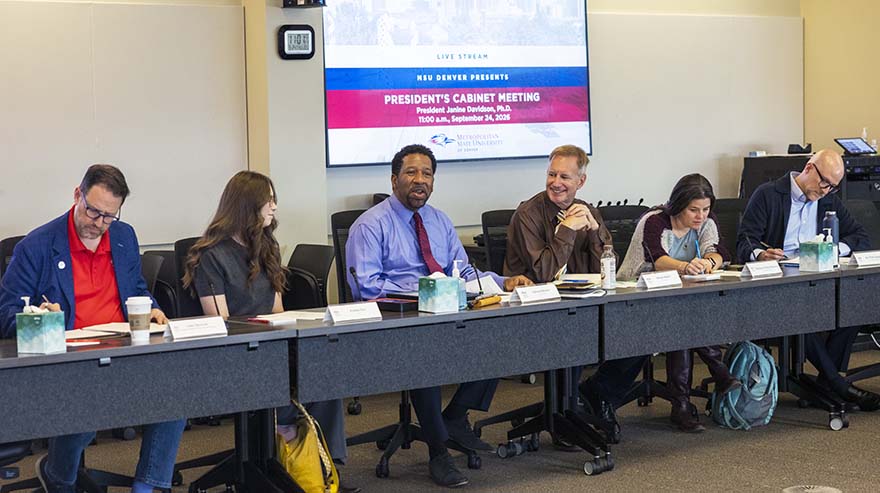





The committee that advises President Janine Davidson, Ph.D., on Metropolitan State University of Denver’s annual budget plan has recommended a 1.5% pay increase for faculty and staff members, along with restrained spending that prioritizes enrollment, student success and long-term financial stability.
The University Planning and Budget Advisory Committee, or UPBAC, also recommended an additional .5% pay increase should the University meet a yet-to-be determined student-success metric, such as enrollment or retention performance.
The committee’s $244 million spending blueprint for the fiscal year beginning July 1 will help inform the University’s fiscal 2027 budget, which Davidson will present to the Board of Trustees for approval next month.
During a planning process that spanned 10 meetings and seven rounds of budget- balancing exercises, UPBAC, made up of representatives from each University branch, navigated considerable uncertainty at the State Capitol. Colorado lawmakers wrestled with significant budget gaps while multiple pieces of pending legislation carried potential implications for education and agency funding statewide.
“This year’s budget process required UPBAC to navigate an unusually uncertain financial and legislative environment,” said Andrew Rauch, budget director and UPBAC facilitator. “The committee worked through evolving state budget projections and pending legislative proposals that could significantly impact higher education funding, while still making informed recommendations aligned with the University’s values and strategic priorities.”
Compensation and benefits recommendations
With state funding uncertainty, flat enrollment assumptions and rising mandatory costs, UPBAC took a measured and cautious approach to new investments and compensation.
Guided by Davidson’s annual budget charge — a map of University spending priorities — the committee reinforced the University’s support for employees, proposing:
- A 1.5% across-the-board compensation increase for faculty and administrative employees
- An additional .5% pay increase if the University meets a yet-to-be determined student-success metric, such as enrollment or retention performance
- Preserving the University’s 75% share of employee benefit costs
The pay increases would apply to full-time and part-time faculty and administrative employees.
They would not apply to classified employees, because their compensation is governed by the state of Colorado’s pay structure, and the state did not approve salary increases for classified employees this year.
Tuition increases weigh affordability with revenue needs
UPBAC assumed flat undergraduate enrollment for budgeting purposes in fiscal 2026-27 while incorporating graduate program revenue into the University’s general fund as part of the institution’s evolving budget model. Historically, graduate programs were self-funded by the revenue they generated.
With these revenue assumptions, UPBAC proposed:
- A 3% increase in resident undergraduate tuition, .5% below the maximum increase allowed by the state.
- A 5% increase in nonresident undergraduate tuition, the maximum permitted.
Due to the University’s tuition-lock structure, the increases would apply only to new students and those who no longer qualify for the lock.
Departments campuswide identify savings
The committee recommended funding about $4.09 million in mandatory cost increases and about $273,000 in targeted strategic investments.
UPBAC also reviewed crucial cost-saving and efficiency proposals from branches across the University. Collectively, all 10 branches and offices represented in UPBAC identified about $2.4 million in savings and redistributions to help support institutional priorities and long-term financial health.
Committee members emphasized that this year’s process required balancing competing priorities while remaining aligned with MSU Denver’s mission and values.
“These recommendations reflect the committee’s effort to thoughtfully navigate difficult trade-offs while keeping students and employees at the center of the conversation,” Rauch said.
New spending targets student recruitment and retention
Proposed new spending includes:
- $115,000 for the undergraduate teaching assistant program, known for driving student retention.
- $39,500 to fund a part-time employee in the Bursar’s Office, which will bring outsourced services in house, allowing for future cost savings.
- $118,750 to support marketing and recruitment efforts.
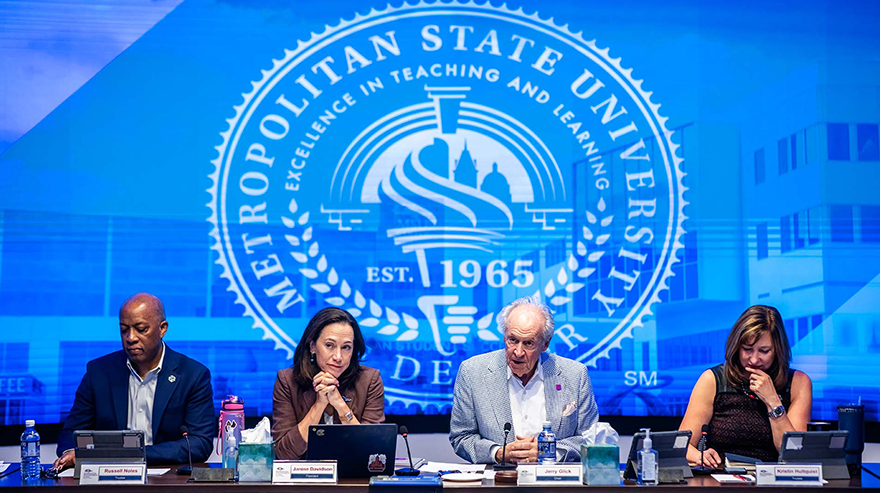
Davidson will weigh UPBAC’s recommendations with suggestions from senior leaders to develop a final budget proposal that will be presented to the Board of Trustees for approval at its June 12 meeting.