



Key takeaways:
- A landmark year is ahead, with Summit House, the Kemper Classroom to Career Hub, the Gina and Frank Day Health Institute Tower, and Workday Student expected to come online by next fall.
- Enrollment and finances remain stable, with full-time degree-seeking undergraduate enrollment up nearly 5% and first-time student enrollment up 2.1%.
- Philanthropic momentum continues, with $117.5 million raised through Roadrunners Rise, a record $26.6 million fundraising year and new multiyear financial planning underway.
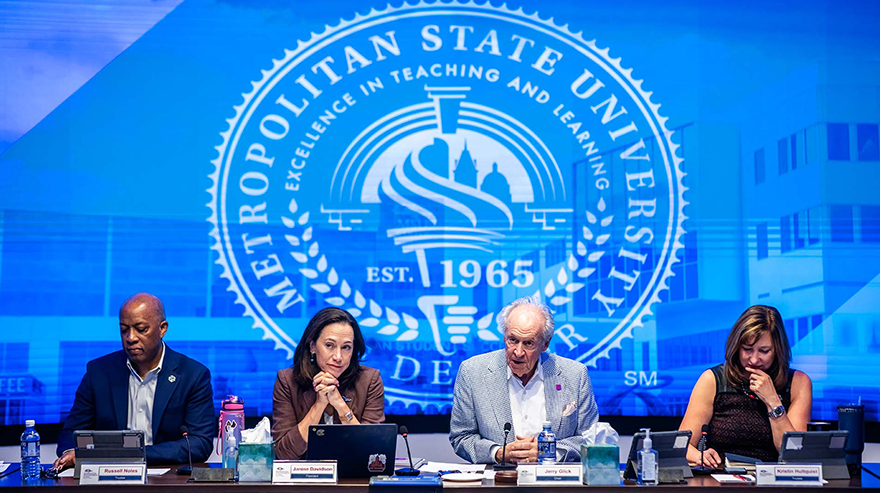
Metropolitan State University of Denver’s Board of Trustees received updates Thursday and Friday on fall enrollment, long-term financial planning and preparations for major initiatives coming online next fall.
President Janine Davidson, Ph.D., described MSU Denver as holding a strong financial position, maintaining overall enrollment and benefiting from growing philanthropic support, evidence, she said, that the University’s flywheel strategy is producing results.
“The flywheel genuinely is working,” Davidson said. “We’re moving and gaining momentum.”
A new era is taking shape
Davidson challenged the University to “meet the moment” and build on its momentum during a consequential year.
By next fall, Summit House and its centralized Kemper Classroom to Career Hub, the Gina and Frank Day Health Institute Tower and Workday Student are expected to come online — creating a more connected college experience for Roadrunners.
“This is a huge year for MSU Denver,” Davidson said. “We’ve built the foundation, but we are not going to sit still.”
Enrollment remains stable as full-time and first-time populations grow
Preliminary fall census data show overall enrollment of 18,010 students, down 1.8% from last fall. Much of the dip came from state funding cuts to the ASCENT program, resulting in fewer high school students taking college-level courses.
MSU Denver welcomed 9,933 full-time degree-seeking undergraduate students, an increase of nearly 5%, while the number of first-time students grew 2.1%.
With concurrent enrollment outside the University’s General Fund operating budget and fall full-time equivalent enrollment (measured by total student credit hours) above fiscal year 2027 budget projections, the University has a positive budget outlook with sustained spring enrollment.
Philanthropy reaches new heights
Christine Márquez-Hudson, president and CEO of the MSU Denver Foundation, reported that the Roadrunners Rise campaign closed with $117.5 million raised. MSU Denver also recorded its strongest fundraising year to date, raising $26.6 million in fiscal 2026.
Planning beyond a single budget year
Andrew Rauch, executive budget director at MSU Denver, presented an initial framework for multiyear financial planning. The approach is intended to help the University anticipate longer-term revenue and spending needs and make strategic decisions aligned with enrollment, workforce, technology and infrastructure priorities.
Rauch and the budget team plan to present a multiyear financial model as part of the fiscal 2028 budget process.
Trustee Marissa Molina reflects on historic service
Trustees recognized Marissa Molina as she concluded nearly eight years of service on the board. Appointed at age 26, Molina was the first DACA recipient to serve on a Colorado state board.
Molina reflected on her path, moving from being shaped by governing boards to helping shape the future of MSU Denver and its students.
“I leave hoping that if I did anything, it was to help make this table a little bigger for those who will come after me,” she said.
ASSET policies remain in effect
Davidson also addressed the U.S. Department of Justice lawsuit challenging Colorado laws that provide in-state tuition and state financial aid to eligible students regardless of immigration status.
She emphasized that nothing is changing. In-state tuition and financial aid policies remain in effect.
MSU Denver remains committed to its mission and to following Colorado law by providing in-state tuition to eligible students who attended and graduated from a Colorado high school and have lived in the state for at least 12 consecutive months. The University will continue monitoring the case with state partners.
Other topics included:
- Discussion on faculty and staff representation, recruitment, retention and belonging, as well as programs supporting employee development and success
- Workday Student implementation and efforts to create a more seamless experience for registration, financial aid and other student services
- The upcoming Higher Learning Commission accreditation visit
- The strategic-plan priorities and legislative outlook
- New coaches and academic success in the Athletics Department