



Key takeaways
- Peer reviewers are on campus today and Tuesday for the HLC accreditation review, with their report expected in about a month.
- Employees can help first-generation students succeed. Leaders encouraged employees to use clear language, explain the “hidden curriculum” and connect students with support.
- Near-term strategic priorities include recruitment, retention and completion efforts, targeted advising, and a new 1-credit seminar for first-year students.
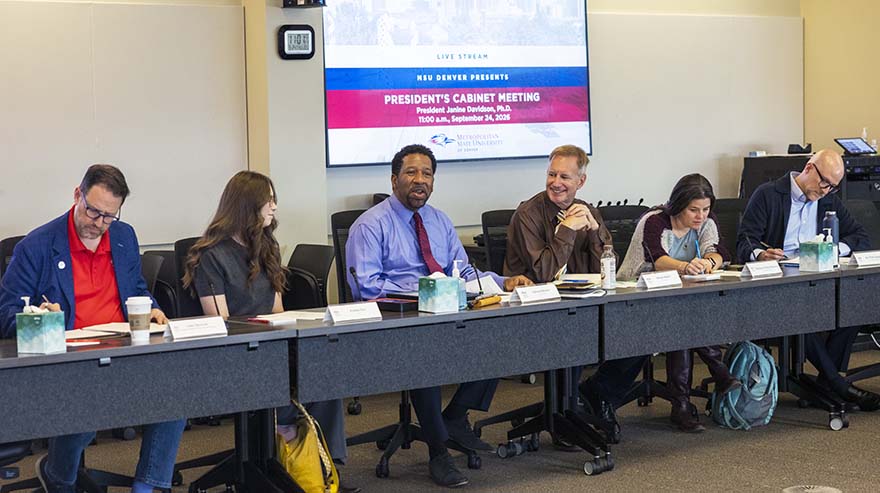
At the President’s Cabinet meeting Thursday, Vice Provost Shaun Schafer applauded the 10-year administrative effort around the Higher Learning Commission site visit this week.
The work by Academic Affairs and other offices to maintain Metropolitan State University of Denver’s institutional status culminates with the campus visit by peer reviewers today and tomorrow. Schafer said the University expects the peer review team’s report within about a month.
Also in the meeting, department leaders shared preliminary fall enrollment results, urged Cabinet members to continue to support first-generation students and reviewed a 2030 Strategic Plan and policy update.
Continuing first-generation success
With 57% of MSU Denver students identifying as first-generation, the President’s Cabinet should continue to add initiatives to support them and embed them into University programs and curricula. That’s what Nahum Kisner, assistant vice president of Student Success, and Rosmina Garcia, associate director of First-Generation Initiatives, asked of the Cabinet.
While spotlighting MSU Denver’s Champion status in the FirstGen Forward Network, Kisner and Garcia offered several ways employees can contribute. They encouraged employees to use clear language that avoids unexplained acronyms and help students navigate the “hidden curriculum” of higher education. Faculty can also identify themselves as first-generation or as allies in their syllabus statements.
The presenters also shared data showing a 33% six-year graduation rate for first-generation students, compared with a 25% national rate. Postgraduation survey data showed 66% of first-generation respondents were employed after graduation, and 52% were employed full time. Meanwhile, recruitment, first-generation retention and six-year graduation rates all improved by more than 10% year-over-year in 2025.
MSU Denver defines a first-generation student as one whose parents or guardians did not complete a bachelor’s degree in the United States.
Strategic Plan milestones and near-term initiatives
Executive Director of Strategy Meredith Jeffers, Ph.D., walked Cabinet members through the Mission in Motion 2030 Strategic Plan SharePoint site and asked leaders to share it with their teams. The site houses working group rosters, project charters, annual project-management plans, milestones, meeting calendars, and decision and guidance memos.
Jeffers said the University completed the plan’s revise-and-refine phase ahead of schedule and is now focused on implementation and assessment through 2030. Priorities include recruitment, retention, completion, postgraduation outcomes, employer partnerships, civic engagement, employee engagement, fiscal sustainability and capital planning.
Among the near-term initiatives are:
- Plans to launch a 1-credit seminar for first-year students in the spring
- Continued targeted advising
- Completion campaigns and efforts to reduce DFW rates in high-volume general-studies courses
Other updates
Enrollment: The preliminary fall student headcount is 18,010 students, down 1.8% from last fall, though first-time student enrollment increased 2.1% to 2,502. Chief of Staff Edward Brown, filling in while President Janine Davidson was away on University business, attributed a significant share of the decline to reduced concurrent enrollment after state funding cuts.
Survey management: The Cabinet held a first reading of a proposed policy intended to reduce survey fatigue and duplication while creating more consistent processes. Discussion focused on clarifying which surveys require approval, coordinating survey timing and maintaining a broader survey calendar.
Roadrunners Give Back: This year’s initiative drew 131 volunteers to 12 sites across Denver, supporting organizations focused on needs that include food access, health, recreation and youth development.
Faculty Senate: President Brenden Kendall, Ph.D., said the Faculty Senate is reviewing the curriculum process and has charged an ad hoc committee with developing foundational principles for the role of artificial intelligence in teaching and learning.
Shared governance: The Student Advocacy Council is gathering student feedback and preparing for the effects of on-campus housing, and the Council of Chairs and Directors is turning its attention toward Workday Student change management and training.
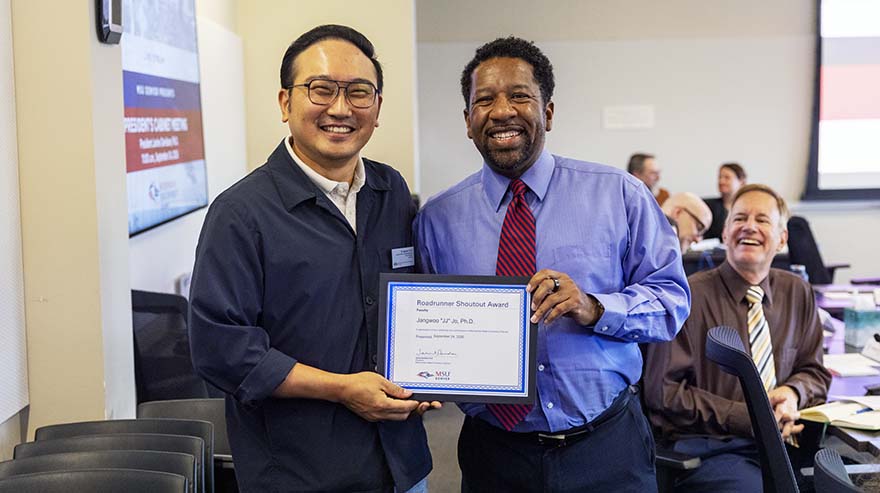
Chief of Staff Edward Brown, Jr., with Roadrunner Shoutout Award faculty winner Jangwoo 'JJ' Jo. Photo by Amanda Schwengel
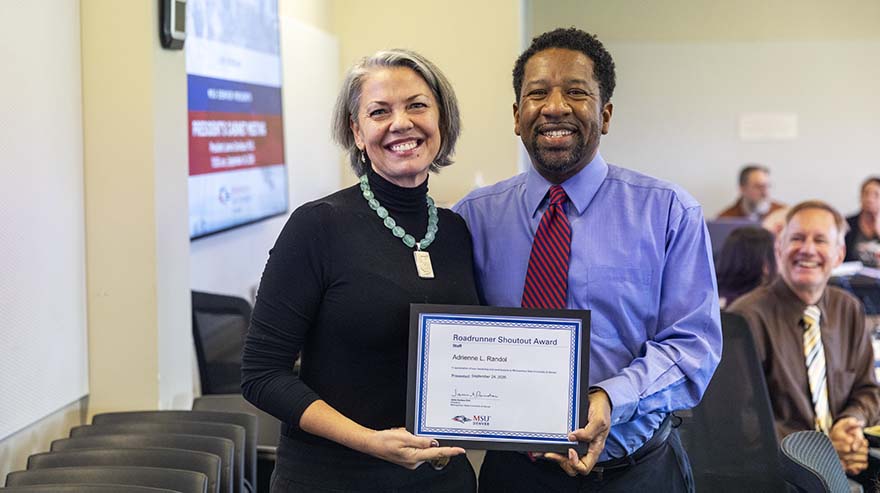
Chief of Staff Edward Brown, Jr., with Roadrunner Shoutout Award staff winner Adrienne Randol. Photo by Amanda Schwengel
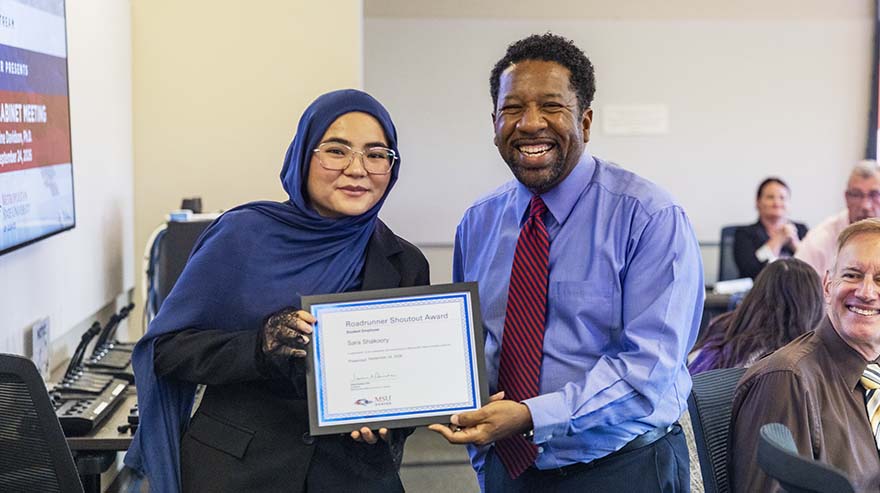
Chief of Staff Edward Brown, Jr., with Roadrunner Shoutout Award student winner Sara Shakoory. Photo by Amanda Schwengel
Roadrunner Shoutouts recognize campus contributions
The Cabinet recognized three Roadrunners for contributions to University operations, student support and academic policy:
Jangwoo Jo, associate professor in the Rita and Navin Dimond Department of Hotel Management, was recognized for his impact as the new chair of the Academic Policies Committee.
Adrienne Randol, policy and records manager, was recognized for bringing structure, collaboration and clarity to policy and records processes while building partnerships across the University.
Sarah Shakuri, student office assistant in Enrollment and Student Affairs, was recognized for providing welcoming, professional administrative support and taking initiative across the office.