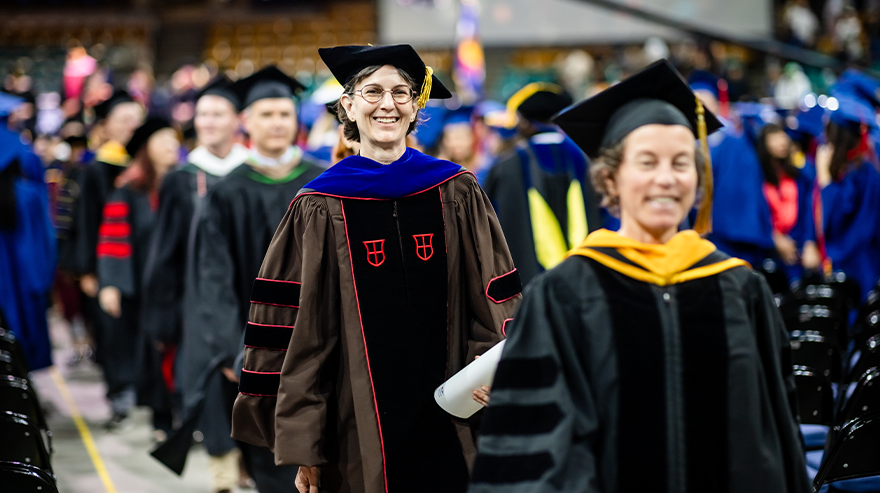





Last semester, over 90 faculty members across Metropolitan State University of Denver collaborated with undergraduate teaching assistants to enhance classroom support, improving retention rates.
The TA program is led by co-directors Rebecca Forgash, Ph.D., professor of Anthropology, and Philip Bernhardt, Ed.D., professor of Secondary Education, and launched in fall 2020. It has supported nearly 19,000 students across more than 1,320 course sections, the majority of which are at the 1000 and 2000-level, often a critical point for student retention. TAs can be used in any undergraduate class. Unlike traditional programs, MSU Denver TAs support professors rather than teach courses.
“Students in courses with a teaching assistant benefit from having that peer connection,” said Shawn Worthy, Ph.D., professor of Human Services. “They often feel more comfortable asking their TA questions and seeking help navigating the course. Students who are struggling especially benefit, as they receive more individualized attention and support.”
Worthy, who partnered with a TA in his Research Methods or Family Systems courses, said the program has had a positive impact not only on students but also on instructors and TAs. “I truly appreciate having a TA. They make my job easier and help improve student outcomes. I also enjoy working closely with my TA, whether that’s through professional guidance or helping them apply to graduate school or jobs with letters of recommendation.”
Program impact by the numbers
Since fall 2020, TAs have supported courses with 53% students of color and 58% first-generation students enrolled, helping to close equity gaps in access, belonging and academic success.
The TA population itself is also reflective of MSU Denver’s commitment to equity, with 44% of TAs identifying as students of color and 53% as first-generation college students.
“The program benefits everyone involved,” Bernhardt said. “Faculty gain meaningful instructional support, students in the classroom engage more deeply with the material, and the TAs themselves develop essential skills in leadership and pedagogy. It’s a scalable, research-supported instructional model for improving student success and building a stronger academic community. For students like Katherine Abbott, serving as a TA has been both a professional springboard and a personal confirmation that she’s on the right path.
“I affirmed that I have a passion for teaching at any level,” said Abbott, who supported Dennis Lance Rudnick, Ph.D.’s EDU 1111: Affirming Diversity course. “The skills I learned in communication, teaching and tech are applicable not just to my studies, but to my teaching career and graduate school journey.”
Faculty: Apply now for spring
To hire a TA, faculty must first apply for funding. Faculty in all schools and colleges are encouraged to apply, and applications for spring 2026 open Nov. 10 and close Dec. 3. As part of the program, teaching assistants have the opportunity to be paid for their work.
TA responsibilities may include:
- Holding office hours
- Leading discussion groups
- Identifying students needing additional support
- Attending and assisting with class sessions
- Co-developing course content or materials
For faculty, the benefits are both practical and pedagogical. “TAs make your life easier in so many ways,” said Kathryn Young, Ph.D., professor of Secondary Education. “They offer unique insights and real-time feedback that can shape course improvement. I don’t know why anyone wouldn’t want to work with a TA.”
To apply for a teaching assistant in spring 2026, you can find the application here.
Questions? Contact TA program co-directors Philip Bernhardt or Rebecca Forgash.