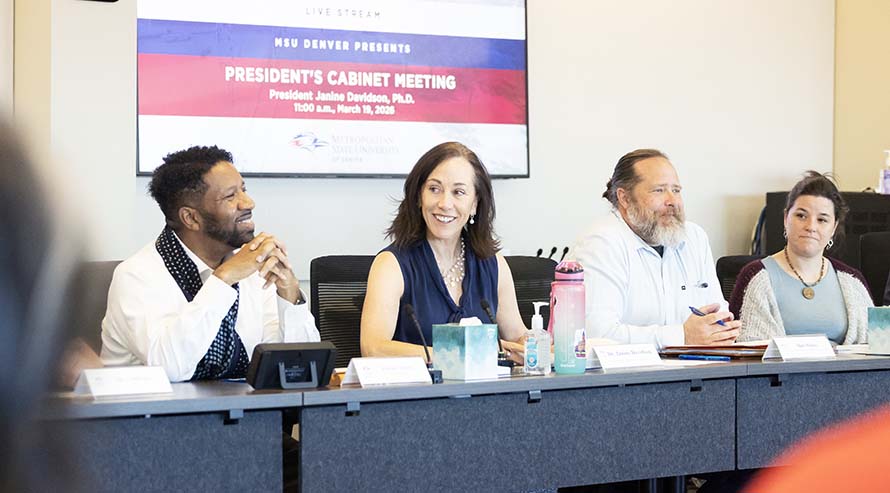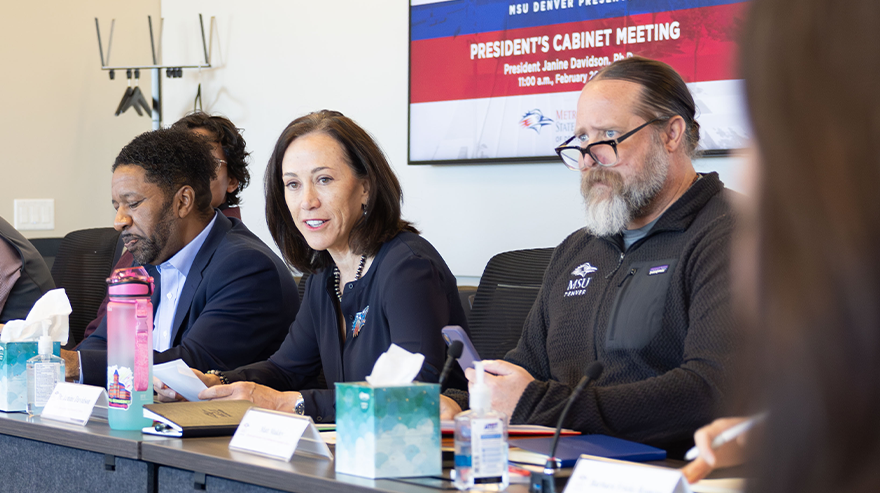




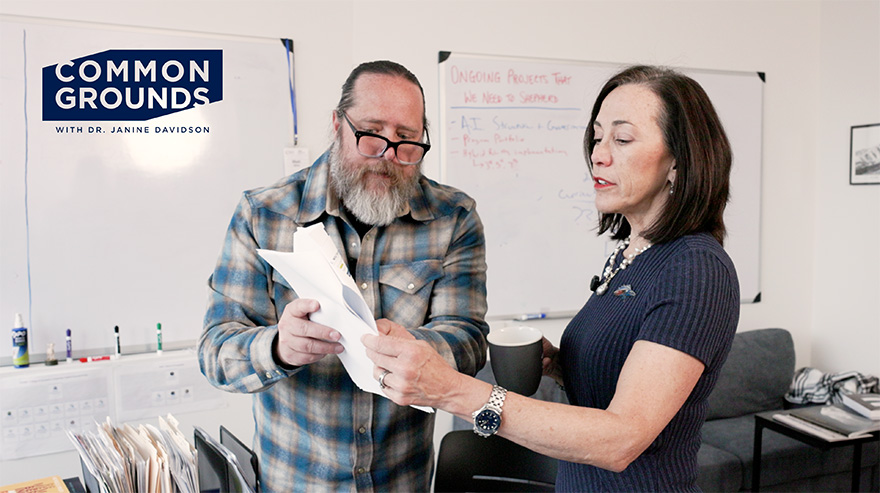
In episode two of Common Grounds, President Janine Davidson, Ph.D., sits down with Provost Matt Makley, Ph.D., to discuss leadership changes, evolving workforce expectations and how MSU Denver is preparing students for long-term career success in a rapidly shifting economy.
Watch the full episode here:
In this episode:
(0:48) Leadership Changes: Why transitions at the dean level are a normal part of a healthy university and how decisions are guided by long-term sustainability and continuity.
(3:20) Return on Investment (ROI): Addressing national conversations about the value of a degree, especially for first-generation students.
(5:30) Adapting to a Changing Job Market: Why volatility — including shifts driven by AI — requires preparing students for multiple careers, not just one job.
(7:00) Reframing Career Outcomes: Why degrees like history or theater lead to diverse, high-impact careers, plus the need to better tell that story.
Your questions
Before each episode airs, the Early Bird takes your questions for campus leaders.
From Lori in the C2 Hub:
Given MSU Denver’s founding mission of career readiness and its growing role as an HSI, how are we integrating culturally responsive practices and social-emotional learning into experiential learning opportunities, such as apprenticeships and the C2 Hub, to better support first-generation students from diverse backgrounds in achieving workforce success?
Provost Matt Makley:
A: MSU Denver’s commitment to career readiness and its role as a Hispanic-Serving Institution are grounded in a strong academic foundation that prepares students to engage meaningfully in experiential learning. Our General Studies program—including requirements in ethnic studies and social justice, global diversity, arts and humanities, social and behavioral sciences and history—ensures that all students can develop cultural awareness, critical thinking and an understanding of diverse perspectives.
These elements are central to culturally responsive practice and support students’ social-emotional growth. As students move into applied settings such as apprenticeships and the C2 Hub, we hope that they bring this foundation with them, enhancing their ability to navigate diverse workplaces and communities. This integrated approach helps position first-generation and historically underserved students for success by aligning academic preparation with real-world experience. It is a primary reason we insist on maintaining our comprehensive approach to university education.