



From the origin of marine microbes in a landlocked lab’s petri dish to the invented language of a renowned and controversial French novelist, Metropolitan State University of Denver faculty are curious about a lot of things. And many of them back up their interest with research.
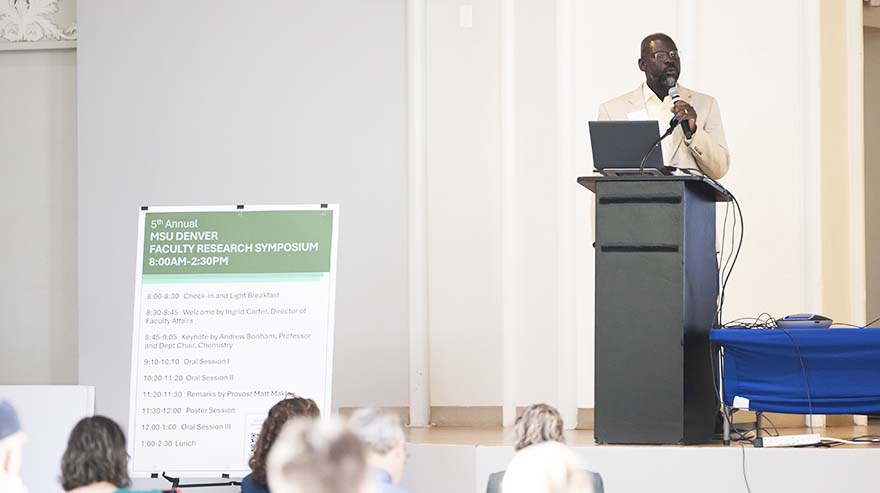
Their inquiries and findings were on display at the fifth annual Faculty Research Symposium, Oct. 23 at St. Cajetan’s Center.
Keynote speaker Andrew Bonham, Ph.D., professor and chair of the Department of Chemistry and Biochemistry, led off the nearly daylong event by acknowledging that at MSU Denver, “our mission is very student- and education-focused,” which can make finding time for research difficult.
But, he said, “We have to fit it in because it’s important. It keeps us current in our field,” and, he said, provides invaluable opportunities for students when they work alongside researching faculty. Bonham said he has worked with 54 students on various research projects. Of those, 21 have authored and coauthored published papers, and 27 have gone on to pursue advanced degrees.
Later, Provost Matt Makley, Ph.D., thanked faculty members for their work exploring ideas and producing research. “This is what our city needs, what our state needs, what our country needs,” he said. “It reaffirms that what we do as professors, as faculty members, serves our community.”
The topics of the research presented Friday were as varied as classes offered at MSU Denver, and represented most of the colleges and many of the departments, including Industrial Design, Physics, Education, Hospitality, Social Work and Business.
Not surprisingly, AI was a recurring theme:
- Finance instructor Matthew Sommer investigated the level of AI involvement clients will accept from financial advisers.
- Computer Sciences Associate Professor Steve Geinitz, Ph.D., studied augmenting traditional education with AI, rather than completely automating classroom connections.
- Psychological Science Professor Bethany Dillen, Ph.D., looked at how parents use AI for child-rearing advice.
- Thyago Mota, an associate professor of Computer Sciences, studied the impact of AI on software engineering.
- Geology instructor Richard Ashmore explored what changes occur when AI is integrated into a course.
- And Assistant Professor of Marketing Kwabena Peprah, DBA, partnered with the CTLB to produce Canvas AI learning modules and observe student engagement with them.
The module, Peprah said, was designed to enhance students’ AI literacy and to get students thinking about ethical considerations when using artificial intelligence.
It’s a topic that needs further exploration, he said. And, “future topics of research could involve data centers.”